
Table of Contents
- How to Decide Whether a Card Is Worth Grading
- How to Check a Trading Card's Condition
- How to Estimate a Card Grade Before Submission
- Raw vs Graded Card Value: Understanding the Premium
- Card Grading Costs and Fees: Is the Investment Justified?
- Rarity, Demand, and Market Value: The Real Factors That Matter
- A Repeatable Pre-Submission Inspection Workflow
- Common Mistakes to Avoid When Evaluating Cards for Grading
- Frequently Asked Questions
Last Updated: October 21, 2026
How to Decide Whether a Card Is Worth Grading
Every collector asks the same question: is this card worth grading? The answer depends on condition, rarity, and market value. A card worth grading must meet a threshold across all three. Most cards don't.
Grading costs money, turnaround can stretch weeks or months, and a lower-than-expected grade means you've paid for authentication on a card that may have lost value.
We are building our platform around consistent, transparent grading, clear pricing, and realistic turnaround times, which are key for serious collectors to make this decision systematically. The process starts with honest evaluation.
The first filter is condition. A card in poor condition rarely justifies grading fees. Soft corners, heavy edge wear, or visible creases mean grading won't unlock significant value, and the authentication premium won't offset the cost.
The second filter is rarity. Common cards, even in excellent condition, don't benefit from grading. Grading services authenticate and preserve but can't create demand.
The third filter is market demand. Some cards command premium prices when graded. Others sit in inventory for months. Understanding which category your card falls into separates profitable submissions from expensive mistakes.
How to Check a Trading Card's Condition
Condition assessment is where most collectors go wrong. A card that looks good isn't necessarily grade-worthy. Graders evaluate centering, corners, edges, and surface under strict standards, and flaws invisible to the naked eye drop grades significantly.
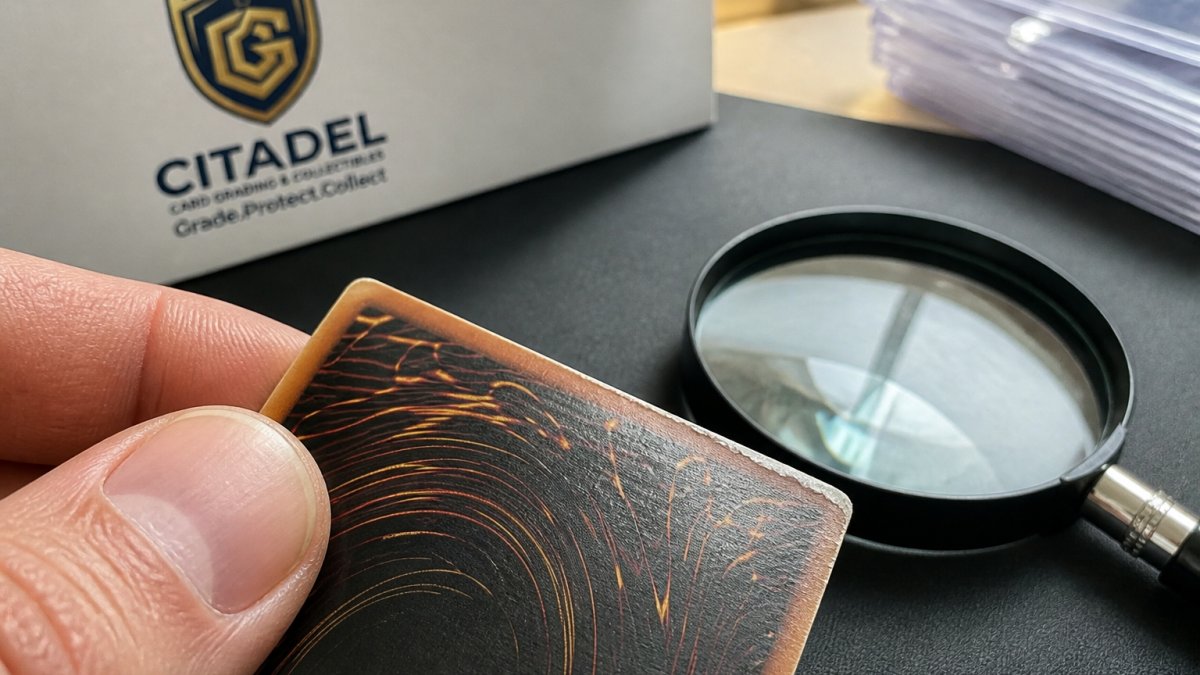
Start with basic visual inspection in natural light, not under a lamp, which can hide flaws. Check front then back for creases, bends, stains, or discoloration. Any of these likely puts the card below grade 8 (Very Fine). Most cards worth grading sit at grade 8 or higher.
Centering, corners, edges and surface inspection
Centering is how the image sits within the card borders. Perfect centering is rare, and noticeable drift toward one edge loses grade points fast. An off-center but otherwise pristine card might grade 7 instead of 9, a difference worth hundreds of pounds for high-demand cards.
Corners tell you almost everything. Even slight rounding visible only under magnification triggers grade reductions, and sharp corners are hard to preserve. Run your fingernail gently along each corner; any softness or rounding is the single most common reason cards grade lower than expected.
Edges require similar scrutiny. Look at the spine from the side; whitening, where the card's core shows through the printed surface, is a major flaw. Light edge wear invisible to casual inspection is obvious to a grader under magnification.
Surface inspection comes last. Lay the card flat and tilt it under light; scratches catch the light. Print defects are permanent, and stains or discoloration are deal-breakers. Most cards have minor surface wear; the question is whether it's minor enough to preserve value after grading fees.
How to Estimate a Card Grade Before Submission
Before you submit, estimate the grade your card will receive. This determines whether grading makes financial sense.
Grading services use a 1-to-10 scale. A grade of 9 (Mint) or 10 (Gem Mint) commands significant premiums. A grade of 7 (Very Fine) or 8 (Near Mint-Mint) may not justify the cost. Anything below 7 almost never justifies submission unless the card is rare or historically significant.
To estimate your card's likely grade, compare it to graded examples of the same card via sold listings on online marketplaces.
Be conservative. Graders apply standardized criteria alongside thousands of other cards, and the bar for each grade is consistent and high. If you're uncertain whether your card reaches a specific grade, assume one grade lower to prevent costly surprises.
Document your assessment: estimated grade for centering, corners, edges, and surface, plus notes on visible flaws. When the card returns, you'll know whether the grade was fair or a re-grade is worth considering.
Raw vs Graded Card Value: Understanding the Premium
A raw card is ungraded and unslabbed. A graded card has been authenticated and encased in a protective holder with an assigned grade visible. The difference in value can be substantial, or minimal, depending on the card.
For highly sought cards, grading creates a significant premium. A raw card worth £100 might be worth £300 graded 9. Collectors pay for certainty: the card is genuine and preserved to a specific standard.
But this premium only exists for high grades. A raw card worth £100 that grades 7 might be worth £120 graded, a £20 gain that's a loss once you factor in fees and wait time.
The critical question is: what grade will your card actually receive? If you're confident it will grade 8 or higher, grading likely makes sense. If you think it will grade 7 or below, the premium disappears and grading becomes a cost with minimal return.
Research comparable sales: what raw versions sold for recently versus graded versions at your predicted grade. The difference is your potential premium. Subtract the grading fee and submission time; if the result is positive and substantial, submission makes sense.
Card Grading Costs and Fees: Is the Investment Justified?
Grading fees vary by service and turnaround speed. Faster turnaround costs more. Standard submission takes longer but costs less. For most collectors, the decision comes down to whether the potential value gain exceeds the total cost.
To calculate true profitability, you need to know:
- The grading fee itself
- The current raw card value
- The estimated graded value at your predicted grade
- The time your money is tied up during submission
Many collectors forget the last item. If grading takes four weeks and your card gains £50, that's £50 on capital locked for a month, a trade-off some collectors won't accept.
For high-value cards, anything worth £500 raw or more, grading fees become a smaller percentage of potential gain. A £2,000 card that gains £500 in value justifies a £50-100 fee easily. For a £50 card, a £30 fee is harder to justify unless the grade premium is substantial.
Ask yourself: if this card doesn't grade as high as I expect, will I still be satisfied? If not, don't submit. Grading is one-way, you can't un-grade a card, and if the result disappoints, you're committed to that grade.
Rarity, Demand, and Market Value: The Real Factors That Matter
Rarity and demand are not the same thing. A card can be rare with low demand, or common but highly sought. Grading works best on cards that are both rare and in demand.
Start by researching your card's print run. How many copies were produced? Cards from early releases, special editions, or limited runs are typically rarer. Rarity creates scarcity, which supports value. But scarcity alone doesn't drive demand.
Demand comes from collectors actively seeking the card. A star player's rookie card has high demand; an obscure player from a defunct league has low demand regardless of rarity.
Market value is where rarity and demand intersect. A rare card with high demand commands premium prices; a rare card with low demand sits in inventory. Before grading, confirm active interest via completed listings on major marketplaces, what similar cards achieved and how quickly they sold.
If your card is common, grading is rarely justified unless it's a particularly iconic card or you're building a high-grade collection for prestige. If your card is rare but has low demand, grading won't create buyers.
A Repeatable Pre-Submission Inspection Workflow
Create a consistent process before submitting any card to prevent costly, emotion-driven mistakes.
Step one: photograph your card in natural light from multiple angles, front, back, corners, edges. These photos document the card's condition before submission if you later dispute the grade.
Step two: compare to graded comps. Find three to five graded examples at different grades and study corners, centering, and surface.
Step three: estimate your grade across each component. Centering: sharp or off-center? Corners: sharp or rounded? Edges: clean or whitened? Surface: flawless or marked? Write these down.
Step four: calculate the financial case. What's the current raw value? What's the estimated graded value at your predicted grade? What's the grading fee? Subtract the fee from the value gain.
Step five: decide. If the financial case is strong and your estimated grade is 8 or higher, submit. If the case is weak or your estimated grade is 7 or lower, hold the card.
This workflow takes an hour per card but prevents expensive mistakes. Many collectors skip it, submit cards based on hope, and regret the decision when grades come back lower than expected.
Common Mistakes to Avoid When Evaluating Cards for Grading
The first mistake is overestimating condition. Collectors see a card that looks good to the naked eye and assume it will grade 8 or 9.
The second mistake is ignoring centering. Centering is one of the easiest flaws to miss in casual inspection but one of the most common reasons cards grade lower than expected.
The third mistake is submitting based on emotion. You love the card, so you assume others will pay a premium for it graded. Market demand doesn't work that way.
The fourth mistake is underestimating grading fees relative to potential gain. A £30 fee on a £60 card is a 50% cost.
The fifth mistake is submitting cards you're not confident about. If you're uncertain whether your card will grade 8 or 7, don't submit.
The sixth mistake is ignoring the time cost. Grading takes weeks or months. Your money is locked up during that time. For some collectors, this matters. For others, it doesn't.
Deciding whether a card is worth grading comes down to honest evaluation and realistic expectations. The cards that justify grading are rare, in high demand, and in excellent condition.
If you're building a collection of high-grade cards or you've discovered a card with significant market potential, professional grading through a trusted service makes sense. Join our newsletter for early access and be among the first to experience a new standard in card authentication and retail.
| Evaluation Step | What to Check | Red Flag |
|---|---|---|
| Condition | Corners, edges, centering, surface | Visible wear, creases, or discoloration |
| Rarity | Print run, production year | Common modern release |
| Demand | Recent sales, active listings | No sales in past six months |
| Grade Estimate | Compare to graded comps | Estimated grade below 8 |
| Financial Case | Value gain minus grading fee | Net return under £50 |
| Market Value | Recent selling prices | Raw value under £100 |
Frequently Asked Questions
Is it worth it to grade my cards?
Whether grading is worthwhile depends on your card's condition, rarity, and current market value. A card worth grading typically has condition that could achieve PSA 8 or higher, rarity that creates collector demand, and a raw value high enough that the grading fee and time investment will be recovered through the value premium. Budget-tier cards, heavily played cards, or common variants rarely justify the cost. Calculate the potential graded value against grading fees and turnaround time before submitting.
How do I know if a card is worth grading?
Assess three factors: condition (centering, corners, edges, surface), rarity or scarcity (print run, edition, variant status), and current market demand. Inspect the card under bright light for creases, whitening, scratches, or print defects. Check recent sold listings for similar raw cards and graded versions to estimate the value premium. If grading costs plus holding time exceed the likely price difference between raw and graded, the card is not worth grading. Focus on cards with minimal visible flaws and documented collector demand.
Does grading a card increase its value?
Grading can increase a card's resale value by providing third-party authentication, preservation, and a standardised condition grade that buyers trust. The value premium varies widely: a high-grade version of a high-demand card may command significantly more than a raw equivalent, while common cards see little uplift. However, grading fees, submission time, and market liquidity must be factored in. A graded card is easier to sell to serious collectors but may take longer to move than a raw card at a lower price.
What condition should a card be in to get a high grade?
High grades require near-perfect condition: perfectly centred, sharp corners with no whitening, clean edges, and a flawless surface free of creases, scratches, or print defects. Cards that tolerate minor imperfections must still show excellent overall presentation. Most cards with visible play wear, handling creases, or surface flaws will receive lower grades. Before submission, inspect under bright light and compare your card's centering and corner condition to graded examples of the same card to estimate your likely grade.