
Table of Contents
- What Makes the Best Card Grading Service in the UK?
- Card Grading Costs UK: What You Actually Pay
- Card Grading Turnaround Time: Planning Your Submission
- How to Get Cards Graded: A Step-by-Step UK Submission Guide
- Which Cards Are Worth Grading? Pokémon, Sports, and Beyond
- Is Card Grading Worth It? A Decision Guide by Card Value
- Conclusion: Choosing the Right Grading Service for Your Collection
- Frequently Asked Questions
Last Updated: October 15, 2026
What Makes the Best Card Grading Service in the UK?
The best card grading service in the UK gives you consistent, transparent grading, clear pricing, and a realistic turnaround time. At Citadel Cards & Grading, we are building our platform around those three things.
A high grade only matters if other collectors trust the company that issued it. A grade from an unknown or inconsistent grader adds little to resale value, no matter how good the card looks.
So when you compare providers, judge them on four things:
- Consistency of condition assessment across submissions
- Transparency of pricing, service tiers, and timelines
- Communication at every stage, from receipt to return delivery
The Chartered Trading Standards Institute guidance on consumer rights is a useful starting point if a service ever fails to deliver what it promised.
Grading Criteria and Condition Assessment
Every reputable grader scores four sub-grades before arriving at a final number: centring (how evenly the printed border sits within the cut), corners (fraying or rounding), edges (chipping), and surface (scratches, print lines, gloss).
A common mistake is assuming a card that looks clean will grade highly.
Professional evaluation happens under controlled lighting and magnification, with each sub-grade recorded before the final grade. If a grader cannot explain how it reached a number, that is a red flag.
Grading Scales and Numerical Grades Explained
Most grading scales run from 1 to 10, with 10 representing a virtually flawless card. Labels vary slightly between companies, but the meaning is broadly consistent.
| Numerical Grade | Label | What It Means |
|---|---|---|
| 10 | Gem Mint | Flawless or near-flawless; sharp corners, perfect centring |
| 9 | Mint | One very minor flaw, often centring |
| 8 | Near Mint-Mint | Minor imperfections visible under close inspection |
| 7 | Near Mint | Light wear, still highly collectible |
| 6 and below | Excellent to Poor | Increasing visible wear, creases, or damage |
The gap between a 9 and a 10 can mean a modest premium versus a significant one, which is why consistency in condition assessment matters more than the scale itself.
Card Grading Costs UK: What You Actually Pay
Card grading costs in the UK depend on your service tier, submission size, and desired speed. There is no single flat rate, and any provider quoting one should be treated with caution. The useful question is not "what is the fee?" but "what is the total delivered cost per card?"
Most services structure pricing around tiers:
- Value or bulk tier: lower cost per card, longer wait
- Standard tier: mid-range pricing, moderate turnaround
- Express or premium tier: highest cost, fastest handling
- Declared value limits: higher-value cards often cost more to grade
Build a Like-for-Like Quote
Because published fees are not comparable on their own, quote every provider on the same five lines, in writing:
- Grading fee per card at your chosen tier, including any minimum submission size
- Declared value limit for that tier, and the surcharge if a card exceeds it
- Return shipping to your address, and whether it is tracked and signed
- Insurance on the return leg, and the maximum cover per card and per shipment
- Any middleman or handling fee, plus whether the provider is the grader or a forwarding agent
Add those five lines and divide by the number of cards. That figure, not the headline fee, is what you actually pay per card.
The Costs Collectors Forget
Two costs catch collectors out. First, return shipping and insurance are often charged separately, with insurance capped per shipment rather than per card.
A worked pattern many collectors use: add the grading fee, return shipping, insurance, a customs and courier allowance, and the cost of getting cards to the grader.
We are not publishing Citadel Cards & Grading pricing yet.
VAT and Consumer Protection
Grading fees from a UK-based provider normally include VAT where the provider is VAT-registered, so the quoted figure is the figure you pay. Cross-border submissions are different: import VAT and any duty are assessed on the returned goods, and the courier will usually require payment before delivery. If a service fails to deliver what it promised, the Chartered Trading Standards Institute guidance on consumer rights sets out where you stand.
Card Grading Turnaround Time: Planning Your Submission
Card grading turnaround time is the biggest source of collector frustration and varies enormously by tier and provider. Budget for the longest realistic window, not the advertised best case. The key distinction is between the grader's stated processing time, starting when your cards are logged in, and the total delivered time you actually experience.
The Four Stages of Total Delivered Time
- Delivery to the grader: one to two weeks from the UK, longer if shipping overseas, and longer again if a middleman forwards your cards on
- Logging and intake: your cards are received and entered into the system; this queue can be days or weeks depending on the provider's backlog
- Grading and encapsulation: the core assessment and sealing stage, and the only stage most providers quote
- Return delivery: shipping back to you, plus any customs clearance and courier handling
The advertised turnaround often covers only stage three. A service promising "10-day grading" may still take six weeks door to door once intake and return shipping are counted. Ask each provider for current estimates for stages two, three, and four separately, and note the date you asked, estimates move, so an old figure is not one you can plan around.
How to Sanity-Check a Quoted Estimate
A quoted estimate is only useful if you know what it is based on. Ask three questions:
- Is this calendar days or working days? A "10-day" estimate can mean two weeks once weekends are excluded.
- Does it start on receipt or on logging? If intake is slow, the clock may not start for weeks after you post.
- What happens if it runs over? Some providers offer a guaranteed service with a refund or credit if the deadline is missed; most do not.
Value tiers commonly run several times longer than express tiers, and the gap widens during peak periods. If your card's value depends on a particular market window, build in a buffer rather than assuming the best case.
Communication Is Part of Turnaround
Communication matters as much as speed. A slower service that sends status updates at every stage is easier to work with than a fast one that goes silent for months. Before submitting, check whether the provider offers tracked updates, a queryable submission reference, and a named contact if something goes wrong.
Royal Mail guidance on sending valuables is worth reading before you post anything high-value, particularly on insurance limits and what counts as adequate packaging.
How to Get Cards Graded: A Step-by-Step UK Submission Guide
Step 1: Choose your service and tier. Match the tier to the card's value.
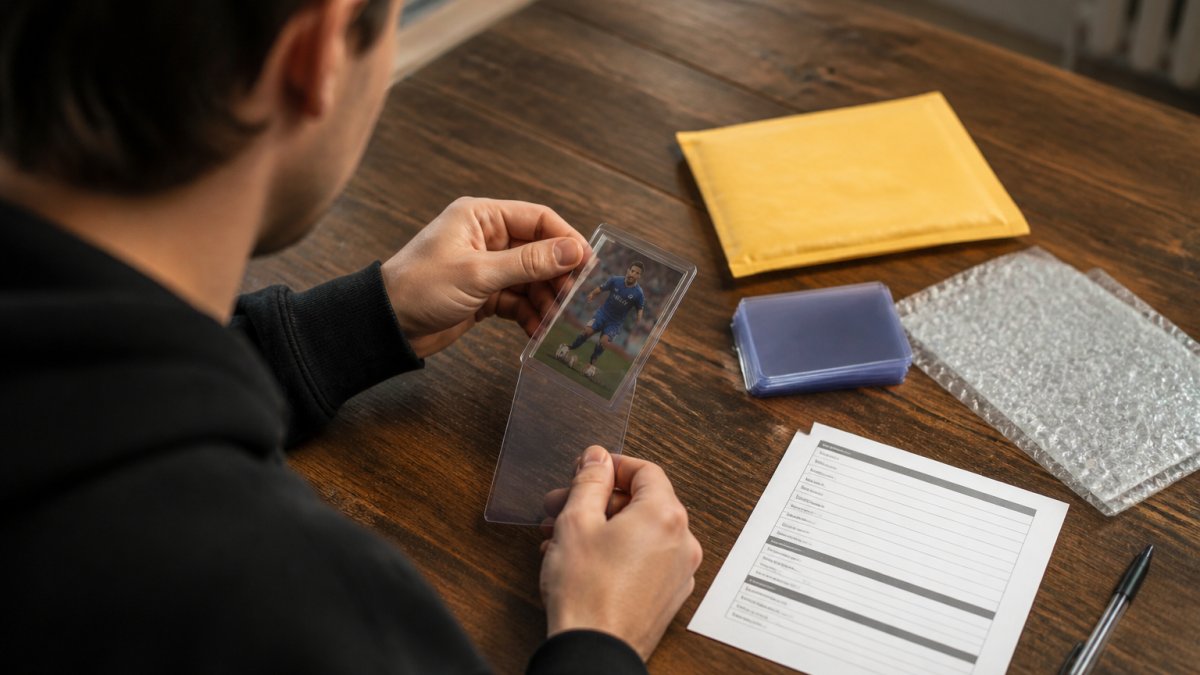
Step 4: Package securely. Use a padded envelope or box with bubble wrap.
Step 5: Ship with tracking and insurance. Declared value should match the sum insured.
Step 6: Track and wait. Monitor the status and keep your submission reference safe.
Step 7: Inspect on return. Check the certification number on each slab against the grader's records.
Packing and Shipping Your Cards Safely
Secure packaging is not optional. Cards that arrive damaged may be rejected or graded lower, and poor packing can void your insurance.
- Use a rigid top loader or card saver for every card
- Sandwich cards between stiff cardboard
- Wrap in bubble wrap so nothing shifts
- Use a tracked, insured service and keep the receipt
A middleman service can handle shipping for you if you would rather not post cards directly. It adds a layer of handling but removes the customs paperwork.
Which Cards Are Worth Grading? Pokémon, Sports, and Beyond
Not every card deserves a slab. Grading pays off when the card's graded value comfortably exceeds your total cost and the card is genuinely in strong condition.
Cards commonly submitted include:
- Pokémon cards, especially vintage first editions and rare modern chase cards
- Sports cards, from football to cricket and boxing
- One Piece, Yu-Gi-Oh!, and Marvel cards, where the TCG market has grown quickly
- Vintage cards from any category, where authentication alone adds value
The rule of thumb: if the card is not worth several times the total grading cost in its likely grade, skip it. A low-value card in a slab is still a low-value card.
Is Card Grading Worth It? A Decision Guide by Card Value
Is card grading worth it? It is worth it when the expected graded value exceeds your total cost, including fees, shipping, insurance, and any customs charges. For low-value cards, it usually is not.
Use this decision guide:
| Card Situation | Grade It? | Why |
|---|---|---|
| High-value card in strong condition | Yes | Grading can lift resale value and confirms authenticity |
| High-value card with visible flaws | Maybe | Authentication still helps, but expect a lower grade |
| Mid-value card, near mint | Yes, if margin allows | Worth it only if graded value clearly beats total cost |
| Low-value card | No | Costs outweigh any premium |
| Card you want to keep forever | Optional | Grade for protection and display, not profit |
For bulk submissions, the maths changes. A few cards rarely justify the shipping and insurance overhead, but bulk submission spreads that cost across more cards, which is why serious collectors often wait and send in larger groups.
Conclusion: Choosing the Right Grading Service for Your Collection
The hardest part of card grading is not the process, it is trusting the company holding your cards. Inconsistent grading, silent delays, and unclear pricing turn a straightforward submission into a stressful one.
Citadel Cards & Grading is building a platform for collectors who want precision and clear communication from the start. You will get early access to our specialised grading and retail offerings, direct updates as we approach launch, and a service designed around transparency in pricing and turnaround.
Frequently Asked Questions
How long does card grading take from the UK?
Turnaround depends on the service tier you choose and where the grading company is based. Economy submissions to overseas graders can take several months, while priority tiers are faster but cost more. UK-based services often return cards in a few weeks. Always check the current estimated processing time before submitting, and factor in shipping both ways. Citadel Cards & Grading will publish its turnaround times at launch, so sign up for the newsletter for updates.
Is it worth getting a trading card graded?
It depends on the card's raw value and condition. Grading makes sense when the card is valuable enough that a high grade significantly increases resale value, or when you want authentication for a rare piece. For low-value cards, the submission fee and shipping can outweigh any gain. As a rule, if the card is not worth at least several times the total grading cost in raw condition, grading is unlikely to pay off. Check current market values before deciding.
How much does it cost to get a card graded from the UK?
Costs vary by service tier, declared value, and whether you submit directly or through a middleman. Expect to pay a submission fee per card plus shipping and insurance both ways. Some UK-based services include return delivery in their pricing. Citadel Cards & Grading has not yet announced its pricing, so check the website or sign up for the newsletter for launch details. Always compare total costs, not just the headline fee.
Are UK card grading companies as reliable as international ones?
Reliability comes down to consistency, transparency, and authentication standards, not location. Some UK services have built strong reputations, while others are newer. Look for clear grading criteria, a verifiable certification number for each slab, and a dispute or re-grade process. Citadel Cards & Grading is poised to become a premier destination for serious collectors, offering professional card services through our upcoming e-commerce platform. Until launch, review any grader's published processes and collector feedback before committing.